
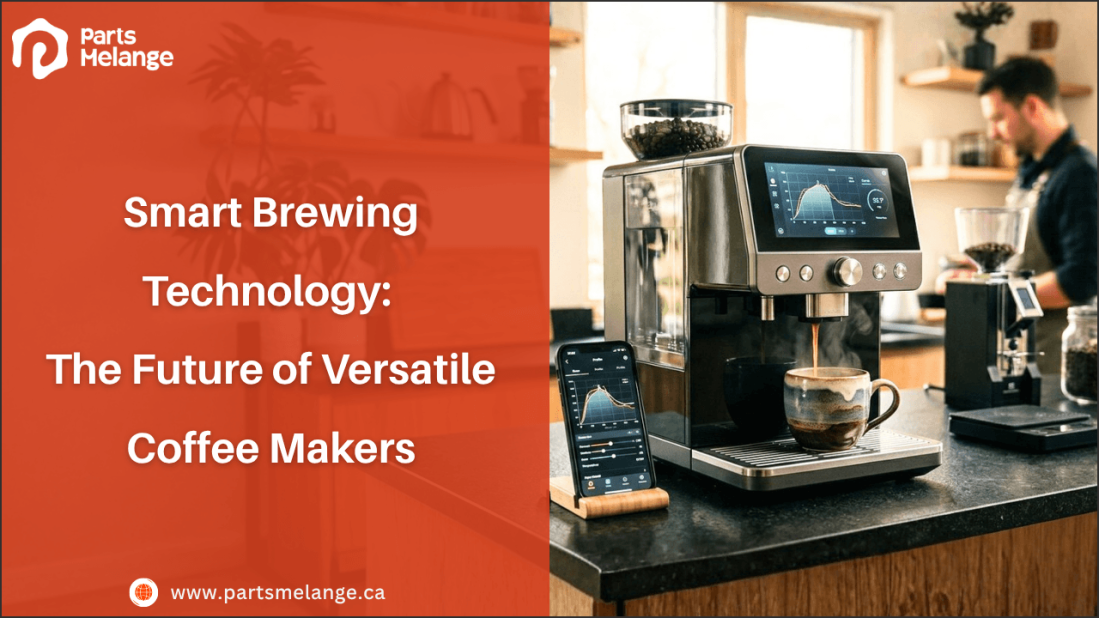
Coffee makers are moving beyond simple timers and heating elements. Smart brewing technology combines sensors, precision heating, connectivity, automation, and increasingly AI-driven software to give users greater control over how coffee is brewed. The result is a new generation of versatile coffee makers designed to make brewing more consistent, personalised, and convenient.
For years, achieving café-quality coffee at home required careful control of several variables, including water temperature, grind size, coffee-to-water ratio, extraction time, and flow rate. Smart brewers are changing that equation by automating many of these variables while still giving experienced coffee drinkers the ability to customise their recipes.
For homeowners, coffee enthusiasts, technicians, and businesses across Canada, understanding how smart coffee makers work can make it easier to identify problems, maintain equipment, and choose the correct replacement parts.
What Is Smart Brewing Technology?
Smart brewing technology refers to coffee-making systems that use sensors, processors, connectivity, and automated controls to monitor and adjust brewing conditions. Unlike conventional coffee makers that generally follow a fixed heating and brewing cycle, smart machines can respond to specific recipes, user preferences, and brewing parameters.
Several technologies make this possible:
PID temperature controllers: Help maintain a more stable brewing temperature by continuously regulating the heating system.
Integrated precision scales: Measure coffee or water quantities to support accurate brew ratios.
Flow and pressure sensors: Monitor how water moves through the coffee grounds and, in some machines, enable detailed extraction control.
Connectivity: Wi-Fi or Bluetooth can enable recipe management, scheduling, firmware updates, and machine data.
AI and machine-learning systems: Can analyse brewing information and user preferences to support automated adjustments and personalised recipes.
The objective is straightforward: reduce uncertainty during brewing while giving users more control over the final cup.
How Do Smart Coffee Makers Improve Coffee Extraction?
Smart coffee makers improve extraction by controlling variables that traditionally depend heavily on the user. Three areas are particularly important: blooming, temperature, and water flow.
1. Automated Blooming
When hot water first contacts freshly ground coffee, trapped carbon dioxide is released. This process is known as blooming.
A controlled bloom gives the coffee grounds time to release gas before the main extraction begins. Smart brewers can automatically dispense a measured amount of water, pause for a programmed period, and then continue brewing.
This approach can provide more consistent saturation than a basic drip cycle.
2. Dynamic Temperature Control
Water temperature has a major influence on extraction. Smart coffee makers can provide more precise temperature control than conventional machines, allowing brewing profiles to be adjusted for different coffees.
For example, a user may prefer different settings for a light roast compared with a darker roast. Instead of relying on one fixed temperature, advanced brewers can support customised temperature profiles throughout the brewing cycle.
This is where precision heating technology becomes particularly valuable. A stable temperature can help reduce fluctuations from one brew to another.
3. Precision Flow Rate and Agitation
Water flow determines how quickly and aggressively water interacts with the coffee bed.
Too much agitation can contribute to uneven extraction, while insufficient contact can produce a weaker brew. Advanced machines can regulate flow rates and, in espresso systems, pressure profiles.
Some espresso machines can even use programmed pressure curves, including lower-pressure pre-infusion followed by controlled extraction and pressure reduction.
The benefit is repeatability: once a preferred recipe is established, the machine can reproduce it with considerably less manual intervention.
Which Smart Brewing Innovations Are Shaping Coffee Makers?
The next generation of versatile coffee makers is increasingly focused on personalisation, connectivity, automation, and recipe control.
App-Based Brewing and Recipe Customisation
Connected coffee makers can use companion apps to give users greater control over brewing parameters.
Depending on the machine, users may be able to adjust:
Water temperature
Brew time
Bloom duration
Coffee-to-water ratio
Liquid yield
Grind settings
Extraction profiles
Brewing schedules
The Fellow Aiden Precision Coffee Maker, for example, includes customisable brewing controls that allow users to work with different brewing settings and recipes. Some systems can also store personalised recipes, making it easier to reproduce a preferred cup.
For coffee enthusiasts, brewing data can provide another level of insight. Instead of simply tasting the result, users can examine information about temperature, pressure, flow, or timing.
RFID and NFC Bean Recognition
RFID and NFC technology can connect coffee beans with brewing recipes. The concept is simple: a coffee package or recipe card can contain information that a compatible machine reads. The brewer can then use the associated recipe or settings.
The xBloom Studio is one example of a coffee maker incorporating RFID technology into its brewing system. This approach shows how coffee identification can be combined with other brewing functions without requiring every recipe to be entered manually.
This technology could make specialty coffee easier to prepare, particularly for consumers who are unfamiliar with adjusting brewing variables. Rather than spending several attempts finding the right recipe, users can start with parameters recommended for a particular coffee.
Interchangeable Baskets and Multiple Brewing Formats
Versatility is becoming one of the defining features of modern coffee makers. Some machines are designed to accommodate different brewing formats, such as single servings and larger batches. Interchangeable baskets can support different coffee-bed geometries, while specialised water-distribution systems can help control how water reaches the coffee bed.
The Fellow Aiden, for instance, is designed around more than one brewing format, while the Spinn takes a different approach by using centrifugal brewing technology for different coffee preparations. These examples illustrate how manufacturers are approaching versatility in different ways.
For households with different coffee preferences, this can reduce the need for multiple appliances.
Voice and Touchless Controls
Smart-home integration can also change how coffee makers are operated. Compatible systems may allow users to schedule brewing or initiate certain functions through connected devices. Touchless controls can be particularly useful in shared kitchens, offices, and commercial environments where convenience and hygiene are important.
The Terra Kaffe TK-02, for example, incorporates connected controls and personalised drink settings, reflecting the broader use of digital interfaces in modern coffee preparation. The exact functions available can vary by machine and connected system.
Check out A Brewing Revolution: How Plastic-Free Technology Is Changing Coffee Consumption to explore how sustainable materials and innovative brewing systems are reshaping modern coffee makers.
How Is Smart Technology Changing the Coffee-Making Experience?
The impact of smart technology extends beyond the brewing mechanism itself. It can change how users interact with coffee makers by introducing different levels of automation, personalisation, monitoring, and control.
Personalised Brewing: Digital recipes and user settings can store or adjust preferences such as brewing parameters, beverage choices, serving sizes, and schedules, depending on the machine.
Automated Brewing Steps: Automation can handle tasks such as grinding, dosing, heating, and water delivery. The level of automation varies between coffee makers.
Greater Access to Brewing Information: Some smart coffee makers provide brewing information through displays or connected apps, helping users understand selected brewing conditions and recipes.
Different Levels of User Control: Smart coffee makers can offer different levels of control, from automated programmes to adjustable settings for users who want to modify individual brewing parameters.
Maintenance and Servicing Considerations: Modern coffee makers may combine sensors, pumps, heating components, grinders, and electronic controls. Maintenance requirements therefore vary according to the machine and manufacturer specifications.
Explore From Bean to Brew: Top 5 Coffee Makers for Every Preference to discover coffee makers suited to different brewing styles, features, and everyday routines.
Conclusion: Smart Brewing Technology and the Future of Versatile Coffee Makers
Smart brewing technology is transforming coffee makers by combining automation, sensors, programmable controls, connectivity, and personalisation to make brewing more consistent and convenient. These technologies can give users greater control over temperature, strength, serving size, beverage preferences, brewing time, and schedules, while future innovations such as AI-assisted brewing, predictive maintenance, intelligent energy management, water-quality monitoring, and smart-home integration could make versatile coffee makers even more responsive to individual routines and preferences.
Key Takeaways
Smart technology makes coffee makers more adaptable to different brewing preferences.
Sensors help monitor brewing conditions and improve consistency.
Automation reduces manual adjustments during coffee preparation.
Personalised settings allow different users to create their preferred drinks.
AI, predictive maintenance, energy management, and connectivity could shape future coffee maker technology.
Looking to maintain or repair your coffee maker? PartsMelange offers high-quality home appliance replacement parts, including filters, seals, gaskets, water pumps, heating elements, switches, and other essential components for different coffee maker maintenance and repair needs.
FAQs
Do I need a Wi-Fi connection to use a smart coffee maker?
Most smart coffee makers will function manually without an internet connection, allowing you to brew basic recipes via physical buttons. However, to access advanced features like recipe downloading, firmware updates, app scheduling, and telemetry data, a Wi-Fi or Bluetooth connection is essential.
Can smart coffee makers adjust for different types of coffee beans?
Yes. Advanced machines allow you to input the roast level (light, medium, dark) or scan the bean packaging. The machine's algorithms will then automatically adjust the water temperature, bloom time, and flow rate to extract the best possible flavor from that specific bean.
Are smart coffee makers difficult to clean?
Actually, they are often easier to maintain than traditional machines. Many smart brewers feature auto-cleaning and descaling cycles, and their companion apps will send you push notifications exactly when maintenance is required based on your actual water hardness and usage data, rather than a generic timer.
Is AI really necessary for making coffee?
While humans have made great coffee manually for centuries, AI eliminates the inconsistency of human error. It can monitor environmental variables and make micro-adjustments to heating algorithms in milliseconds—a level of precision that even the most skilled human barista cannot replicate consistently over hundreds of cups.
Disclaimer: This blog is for informational purposes only and provides general information about smart brewing technology. Features and performance may vary by model and usage conditions. |




Please complete your information below to login.
Sign In
Create New Account